How to solve the polycrisis fast?
An attempt to avoid planetary self-destruction
Can AI be helpful as a policy advisor tool?
The term polycrisis refers to a situation where multiple global emergencies are occurring simultaneously and are so deeply interconnected that they compound one another. The core idea is that the impact of these crises combined is more severe than the sum of their individual parts.
Key Characteristics
-
Interconnectivity: A crisis in one area (e.g., a geopolitical conflict) triggers or worsens a crisis in another (e.g., energy prices or food security).
-
Causal Complexity: Because the problems are entangled, solving one issue in isolation can lead to unintended negative consequences elsewhere.
-
Systemic Risk: The entanglement threatens the stability of entire systems, such as the global economy, the climate, or international political order.
Origin and Usage
The term was originally coined by French philosopher Edgar Morin in the 1990s, but it entered mainstream discourse more recently:
-
Jean-Claude Juncker: Used it in 2016 to describe the "perfect storm" of challenges facing the European Union (the debt crisis, migration, and Brexit).
-
Adam Tooze: The historian popularized the term in 2022 to describe the current global landscape, where the COVID-19 pandemic, climate change, inflation, and the war in Ukraine all feed into each other.
Example of a Polycrisis Loop
-
Climate Change causes extreme weather, leading to crop failure.
-
Crop Failure leads to food shortages and high inflation.
-
High Prices create social unrest and political instability.
-
Instability hinders the international cooperation needed to solve Climate Change.
In short, a polycrisis is not just "many things going wrong at once," but rather a state where multiple crises are entwined, making them much harder to manage through traditional means.
What is the root cause of the polycrisis?
The root cause of the polycrisis is generally not viewed as a single event, but rather as the interconnectedness and mutual reinforcement of failing global systems. It is characterized by a fundamental systemic crisis where multiple shocks—ecological, economic, and social—converge in a way that the whole becomes more dangerous than the sum of its parts. Here are the primary structural drivers:
1. Ecological overshoot
At the deepest level, the polycrisis stems from the tension between an economic model predicated on infinite growth and the finite physical limits of the planet. This isn't just about climate change; it involves biodiversity loss and resource depletion. This ecological pressure acts as a "threat multiplier," intensifying other crises like migration, food insecurity, and geopolitical conflict.
2. Hyper-connectivity and systemic fragility
Global systems (financial, logistical, and digital) have become extremely efficient but also highly brittle. Because our world is so tightly coupled, there are no "firewalls" between sectors. A disruption in one area—such as a supply chain bottleneck or a regional conflict—instantly cascades through other networks, turning localized shocks into global systemic failures.
3. Institutional decoupling
There is a widening gap between the nature of our problems (global, complex, long-term) and our governance mechanisms (national, bureaucratic, short-term). Most institutions were designed for 20th-century stability and struggle to manage 21st-century complexity. This leads to a crisis of legitimacy, where public trust erodes just as coordinated action is most required.
4. Feedback loops and the "symptom trap"
A defining feature of the polycrisis is that attempting to solve one problem often exacerbates another. For example, using certain economic measures to combat inflation might inadvertently deepen social inequality or increase carbon emissions. Because we often treat symptoms rather than systemic causes, the crisis simply shapeshifts rather than resolving.
Summary
The root cause is the loss of equilibrium between human-made systems and the natural world, managed by institutional structures that are no longer fit for the scale and speed of modern challenges.
Can the root cause be defined as a sequence of policy failures?
Yes, the polycrisis can absolutely be viewed through the lens of cumulative policy failures. While the underlying drivers are systemic, policies act as the "operating instructions" for those systems. When those instructions are flawed or outdated, they accelerate the breakdown.
Viewing the polycrisis as a result of policy failure usually focuses on several key governance breakdowns:
1. The "Silo" effect (linear policy in a non-linear world)
Traditional policymaking is specialized: one department handles energy, another handles finance, and another handles social welfare. However, in a polycrisis, these domains are inseparable.
-
The Failure: Policies are often designed to optimize one sector without calculating the negative externalities (side effects) on another.
-
Result: A "fix" for energy prices might accidentally destroy biodiversity or increase long-term national debt, creating a cycle of reactive governance.
2. Short-termism and the "election cycle" trap
Most modern political systems are designed around 4-to-5-year cycles. The polycrisis, however, is driven by "slow-burn" issues like soil degradation, demographic shifts, and climate tipping points.
-
The Failure: Policymakers are incentivized to prioritize immediate "Band-Aid" solutions that please voters today but ignore (or worsen) structural risks that will peak in 10 or 20 years.
-
Result: A massive "governance debt" where the cost of intervention grows exponentially the longer structural changes are delayed.
3. Regulatory capture and path dependency
Policy is often "locked in" by past decisions and powerful interest groups. This is known as path dependency.
-
The Failure: Even when data suggests a radical change is needed (e.g., moving away from fossil fuels or changing debt-based monetary systems), existing policies, subsidies, and legal frameworks protect the status quo.
-
Result: Systems become "too big to fail" but "too rigid to adapt," leading to a catastrophic rather than a controlled transition.
4. Market fundamentalism as a policy default
For decades, a dominant policy trend was the belief that markets would self-regulate and solve resource allocation problems efficiently.
-
The Failure: This policy direction often neglected "public goods" (like a stable climate or social cohesion) because they don't have an immediate market price.
-
Result: Vital social and ecological buffers were stripped away in the name of efficiency, leaving society with no "spare tires" when a major shock hits.
5. Failure of international coordination
Since the polycrisis is global, it requires global policy. However, we have seen a retreat toward nationalism and protectionism.
-
The Failure: The inability to create binding, enforceable international policies on issues like corporate taxation, carbon emissions, and pandemic preparedness.
-
Result: A "race to the bottom" where individual countries' policies undermine global stability.
Conclusion
From this perspective, the polycrisis isn't just an "act of God" or a natural disaster; it is a design failure. It is the result of applying 20th-century administrative logic to a 21st-century complex system. The "crisis" is actually the gap between the speed of global change and the slow, fragmented speed of policy adaptation.
How can we solve the polycrisis?
If the polycrisis is viewed as a result of policy failure, the solution lies in moving away from reactive "crisis management" toward a systemic redesign. This requires shifting from fixing symptoms to addressing the underlying structural errors.
Based on this perspective, here is how the polycrisis can be solved through a fundamental policy overhaul:
1. Integration: breaking the silos
Since the polycrisis is a web of interconnected issues, policy can no longer be made in isolation.
-
The Solution: Implement cross-departmental governance. Every policy proposal should be stress-tested against multiple dimensions—financial solidity, social impact (Maslow’s needs), and ecological limits—simultaneously.
-
The Shift: Moving from "Energy Policy" or "Housing Policy" to "Systems Policy" where the goal is the health of the entire societal organism rather than the optimization of a single sector.
2. Radical simplification and modernization
Much of the current failure stems from "administrative bloat"—layering new rules on top of old ones until the system becomes unmanageable and fragile.
-
The Solution: A policy of Administrative simplification through abolition. Identify and remove advisory bodies and regulations that lack a direct legal basis or proven utility.
-
The Goal: Create a lean, transparent administrative core (e.g., focused on essential data and legal oversight) that can react quickly to shocks without getting bogged down in bureaucracy.
3. Financial re-engineering
If the crisis is fueled by debt and financial instability, the policy solution must change how money flows within the public sector.
-
The Solution: Internalize public debt. Instead of the public sector borrowing from private markets, move toward a system where public money remains in the public system. This prevents capital leakage and ensures that financial resources are directed toward long-term stability rather than short-term interest payments.
-
The Goal: Achieve financial solidity that allows the government to act as a buffer during crises rather than being a victim of market volatility.
4. Maximizing existing assets (the "efficiency first" mandate)
Policy failures often involve ignoring existing resources in favor of expensive new "mega-projects."
-
The Solution: Prioritize the occupancy and utility of existing stock. For example, in housing, policy should focus on breaking down municipal barriers to splitting homes or encouraging home-sharing.
-
The Math: Solving a shortage by increasing the efficiency of what you already have by 10% is often cheaper and faster than building 10% more from scratch.
5. Multi-level scaling (local to global)
Policy failure often happens because we try to solve global problems locally or local problems with a "one-size-fits-all" national mandate.
-
The Solution: Assign policy interventions to their correct dimension.
-
Local: Housing and community resilience.
-
National: Financial systems and legal guardrails.
-
Global: Climate and international solidarity.
-
-
The Goal: Create a "learning network" where countries and cities share successful data-driven models, scaling what works and discarding what doesn't.
6. Data-driven decision making
Policy often fails because it is based on political intuition or outdated dogmas rather than real-world feedback.
-
The Solution: Use a "Master Analysis" approach. Every policy should be a "Proposal" based on a "Mandate" (general public objective), backed by rigorous data analysis.
-
The Feedback Loop: If the data shows a policy is causing a "system error" (a symptom in a different area), the policy must be adjusted immediately based on that measurement.
Summary: The path forward
Solving the polycrisis through policy means moving from complexity to simplicity and from extraction to circulation. By ensuring that proposals are financially solid, data-driven, and focused on basic human needs (Maslow), the state can transition from a source of failure to an engine of resilience.
Modeling and forecasting the polycrisis
The polycrisis Core Model of the Cascade Institute shows the different systems in a overall image of interconnected systems. This model is a great simplification from the the System Model of the Club of Rome in which al these interconnections are calculated in a computer model. The polycrisis and the mechanism of collapse due to exponential growth is emedded in this model. This model is validated in 2020 by Gaya Herrington.
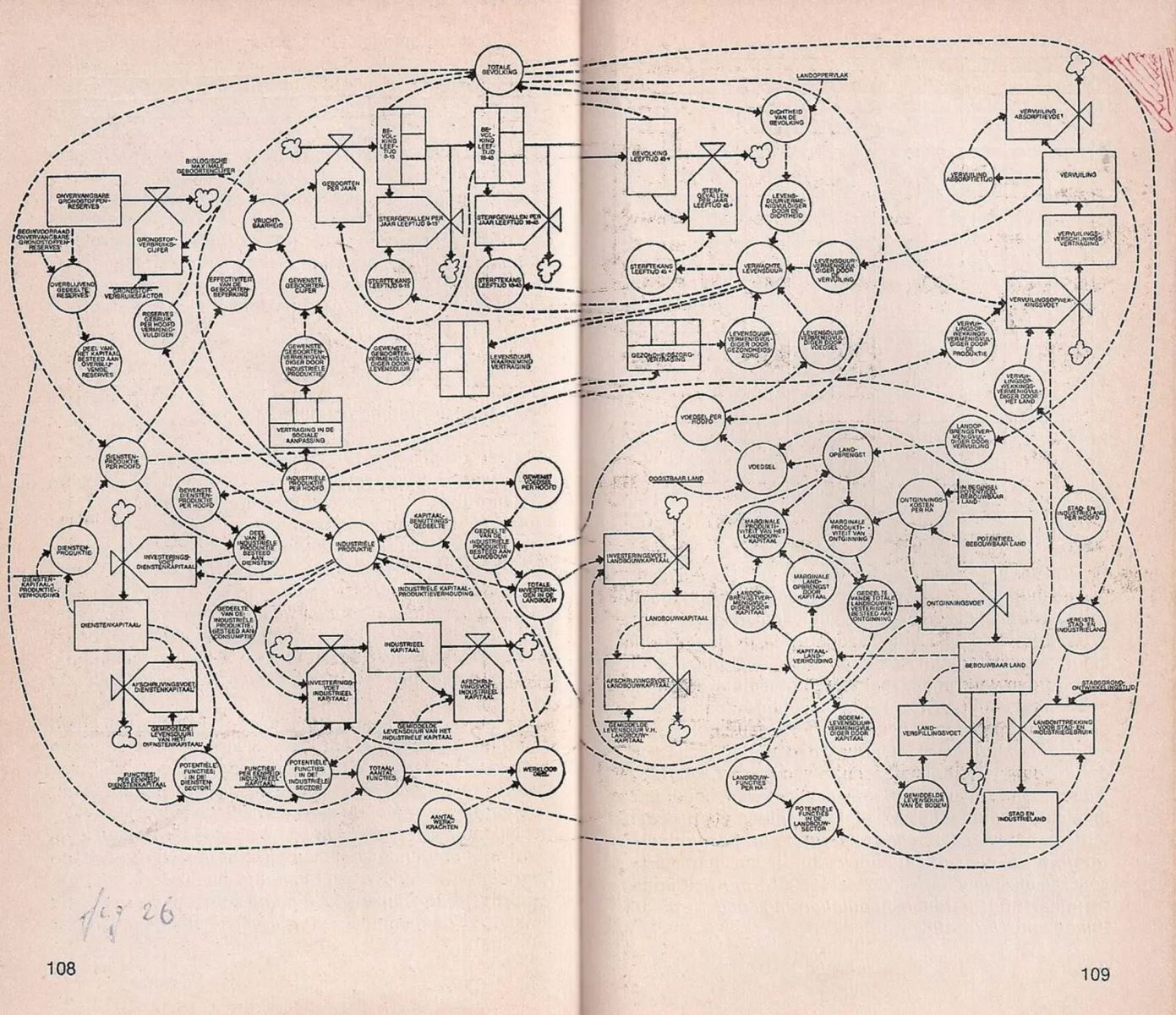
https://onlinelibrary.wiley.com/doi/10.1111/jiec.13084
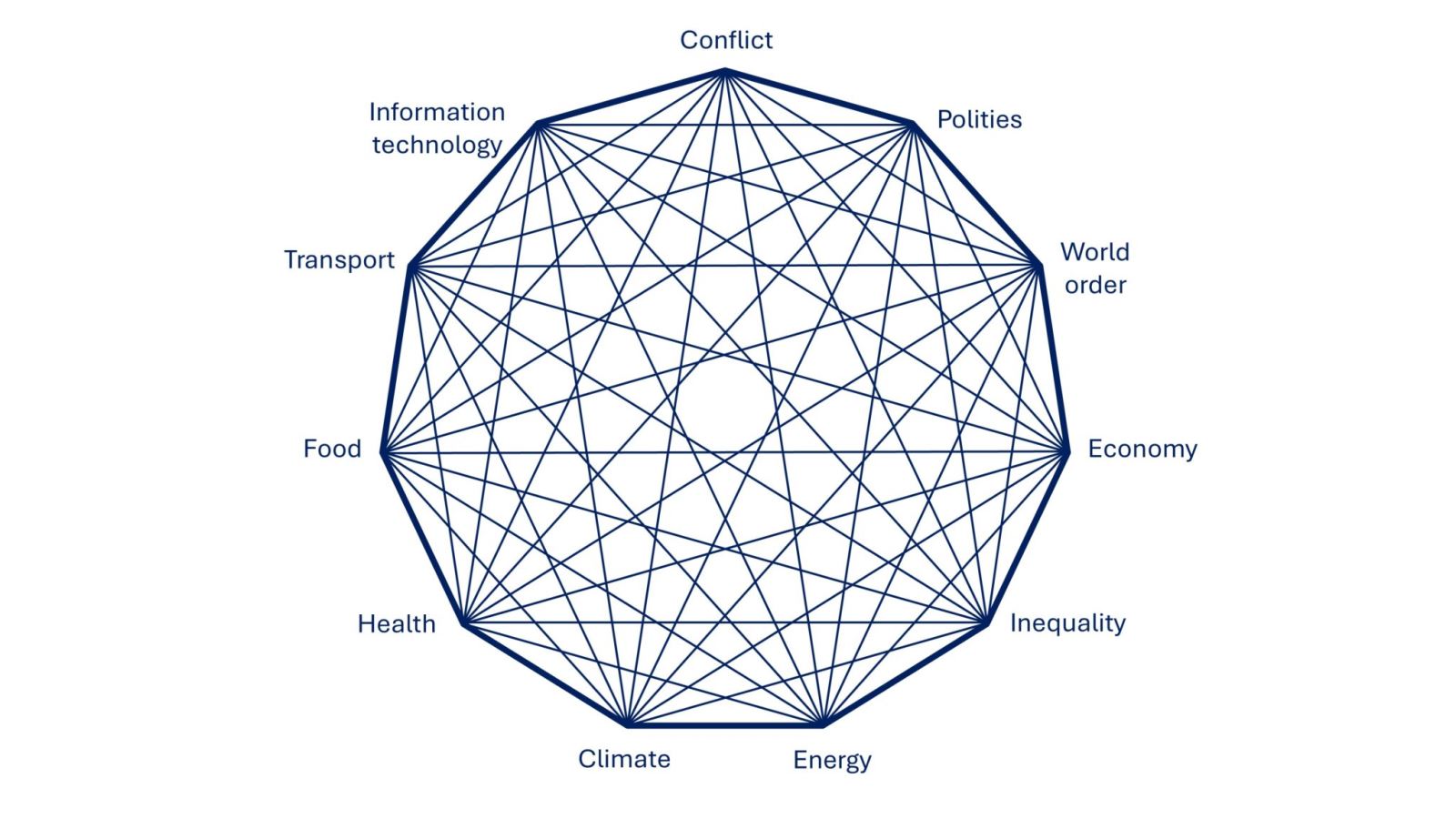
Cascade InstituteL Polycrisis Core Model: https://cascadeinstitute.org/polycrisis-core-model
The political system (or de democracy) is seen of one among equals (polities in the schema above). Also the climate system is shown in the same order. This representation of reality is somewhat problematic for four reasons,
- It ignores the fact that this 'polities' system -with its shortcomings- determines the legal framework in which the societal systems operate. It determines the legal guardrails (i.e. consumer law, climate agreements) and also the fiscal parameters by which companies and consumers make their decisions.
So this system is not hierarchical equal. - The same is valid for the climate system {the biosphere). This also is a limiting- and facilitating factor for human society. Natural resources and stability are the foundations of our existence, wealth and prosperity. By representing this as a subsystem on the same hierachical level als energy it misrepresents realitiy.
- The military is ommited as subsystem, it is a driving force of conflict by itself (military-industrial complex) and a big contributer to climate change (8% of total emissions). The biggest effect is that it sucks financial resources and political attention away from climate policies. So the opportunity costs are immense.
- The power of capital accumulation is not visible. Important decicions are made in board-rooms and behind closed doors. Fundamentally anti-democratic. This mechanism should be envisioned in the model to make it usable as a transformative perspective.
These shortcomings are important because a model helps us to understand reality. And a errornous model causes fundamental mistakes.
In our schema we made it more like the Dougnut economy where the biosphere forms a circle in which our societies have to operate within.
It shows the overshoot of planetary boundaries and also the financial leakages where capital is lost to, for instance, windfall profits and excessive money extraction.
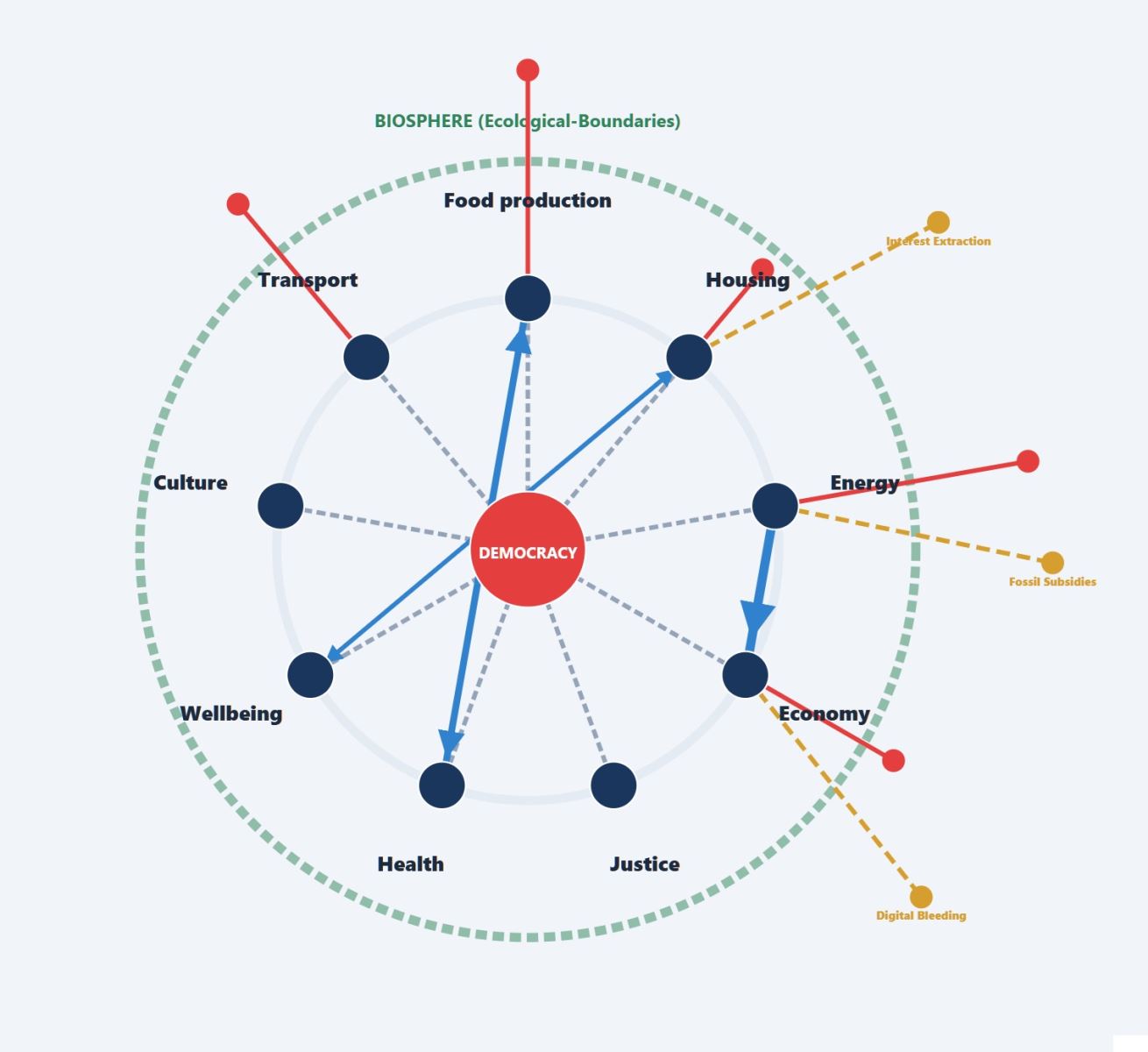
By recognising this institutional role we can see how democracies interact with the systems like transport, food etc. Citizens platform Netherlandse developed a model which gives democracies a role in the total polycrisis framework. It also shows that democracies can be defined as the root cause of the polycrisis by their apathy or wrongdoing in the way they operate. For 6 decades now they failed to play their role in managing the economies into a sustainable path: all talk about energy transition and growth of windturbines and solarpanels did not substituted fossile fuels. It mainly prevented increase of fossile fuel use by absorbing the growth in energy demand. It demonstrates there is no technofix for climate change. We have to change all systems in a orchestrated manner: the polycrsis perspective.
The polycrisis model shows the advantage of moving away from a material oriented society to one which embraces less material values like arts, health, sport, spirituality and culture. This focus brings society within planetary boundaries while offering people a meaningful live.
“People don't need enormous cars; they need admiration and respect. They don't need a constant stream of new clothes; they need to feel that others consider them to be attractive, and they need excitement and variety and beauty. People don't need electronic entertainment; they need something interesting to occupy their minds and emotions. And so forth. Trying to fill real but nonmaterial needs-for identity, community, self-esteem, challenge, love, joy-with material things is to set up an unquenchable appetite for false solutions to never-satisfied longings. A society that allows itself to admit and articulate its nonmaterial human needs, and to find nonmaterial ways to satisfy them, world require much lower material and energy throughputs and would provide much higher levels of human fulfillment.”
Donella H. Meadows
Can the polycrisis be solved?
Collapsologists think collapse is inevitable. And they are right to a certain degree. But in the meantime there is a chance we have time to adapt. A partial breakdown seems unnavoidable due to heating which is underway. But when the plans are there and the sense of urgency emerges things can go with a war-time speed.
When military spending is directed toward stabilising the climate and reducing emissions, thinks can go fast. But we need to have comprehensive plans which are rooted into a solid understanding of the polycrisis and the mechanisms involved. By understanding the mechanisms which accelerate breakdown also the opposite development can be understood: that fixing one problem the right way can help fixing another problem in the next subsystem. The flywheel effect.
For instance:
- diplomatic solutions for military conflict releases resources for climate change and reduces emissions by bombing and military fuel use;
- reduce of feedstock reduces methane emissions and gives room for reforestation;
- reducing use of (fossile based) pesticides reduces emissions and brings greater health, which reduces care-costs, which can be spent elsewhere;
Jason Hickel calculated we can reduce out energy- and material use with 70% and at the same time give the current global population a decent living standard (DLS). Therefore we need a global and per country well orchestrated transition to a democratisation of productive capacity, financial decision making and a focus on regional= and more self sustained economies. Also a focus on more immaterial values like health, sports, arts and culture should give people a meaningful live.
When the pressure of collapse emerges, more and more governments will seek solutions for the emerging problems of food insecurity, droughts and flooding.
For making scenario's we need a model to calculate de policies to realize the desired outcomes. The university of Stuttgart has a computer model to calculate these policies. This is called Cross-Impact Balance Analysis.
https://www.zirius.uni-stuttgart.de/en/forschung/cib-lab/
https://www.cross-impact.org/english/CIB_e_ScW.htm
But also these models are -just like climate models- a simplification of reality. They does nog reflect the possibilities when democratization comes into play.
Examples of economic democracy and fixing polycrisis
Jason Hickel is and economic antropologists (see jasonhickel.org). Why he is mentioned here? The reason is simple: het tries to offer science based perspective for global solutions by connecting the dots of colonial history, climate change, inequality to into viable and urgents perspective on solutions. He recognizes the fundamental changes which are needed. He pressures for a multi-disciplinary approch, needed to address the complexity and interdependancy of the problems we are facing.
Earth4all System Model
This model tries to simulate systemic change.
See https://earth4all.live
This is a great effort to calculate policy outcome. But as said, it is a symplification of reality and does not take into account the specific per country cicumstances,
But AI can manage a lot of data and complexity. So may be this can help managing the polycrisis.
Can AI help managing che complex polciy challenges of the polycrisis?
Yes, using a System Model similar to the one developed by the Club of Rome (specifically the World3 model from The Limits to Growth) is an excellent foundation for an AI-driven strategy.
In a polycrisis, you cannot look at data points in isolation because they are "radioactive"—they affect everything around them. An AI can take the original "System Dynamics" logic of the Club of Rome and upgrade it into a real-time, high-resolution tool.
Here is how AI can apply and enhance that specific model:
1. From Static to real-time data
The original World3 model used static coefficients and historical data to project 100 years ahead.
-
The AI Upgrade: An AI can feed on live global data streams (satellite imagery for crop yields, real-time energy prices, central bank digital flows, and social sentiment from digital platforms).
-
The Benefit: Instead of a "forecast" that might be wrong, you get a "Live Digital Twin" of the global system that adjusts its calculations as the polycrisis evolves.
2. Identifying "system errors" and feedback loops
The Club of Rome's model is famous for its feedback loops (e.g., as resources become scarce, more capital is diverted to extraction, which slows industrial growth).
-
The Role of AI: AI is far superior at detecting non-linear feedback loops. It can identify "System Errors" where a policy intended to help actually triggers a negative cascade.
-
Example: AI could calculate how a specific subsidy in the "Landbouw & Voedselketen" dossier might inadvertently increase the "Zorg-bureaucreatie" due to health externalities, a connection a human analyst might miss.
3. Simulating the "10-Step Strategy"
You can use the Club of Rome model logic to simulate the impact of your 10-step strategy:
-
Step 2 (Target Group): The AI calculates who benefits most from redistributed savings.
-
Step 8 (Legal Guardrails): The AI models the "leverage" of legal actions if the current system resists.
-
Step 9 (Preferendum): The AI can simulate different "Preferendum" outcomes to see which policy combinations provide the highest "Broad Prosperity" (Brede Welvaart) with the least social tension.
4. Project 1 & Project 2: The Modern World3
The AI uses the System Model to run two parallel simulations:
-
Project 1 (Current Policy): The AI runs the "Business as Usual" scenario, calculating the escalating costs of current system failures (e.g., the cost of public debt interest vs. the cost of social unrest).
-
Project 2 (Science-Based Utopia): The AI uses the system's interconnections to find the "Giant Leap" (as seen in the recent Earth4All initiative). It calculates the most efficient pathway to shift the system from decline to a steady-state of wellbeing.
5. Managing the "Maslow" Hierarchy
By integrating the Maslow Pyramid into the system model, the AI ensures that the "Stocks" and "Flows" it calculates (food, energy, money) are always prioritized toward the basic needs of the citizen first. If the model shows that a financial policy threatens the "Biological Needs" (Level 1), it automatically flags it as a system failure.
Conclusion
Using the System Model of the Club of Rome as the "brain" for your AI allows for a holistic analysis. It ensures that "Mandates" and "Proposals" are not just isolated ideas but are mathematically tested against the entire web of global interconnections.
Example: Energy system in the Netherlands
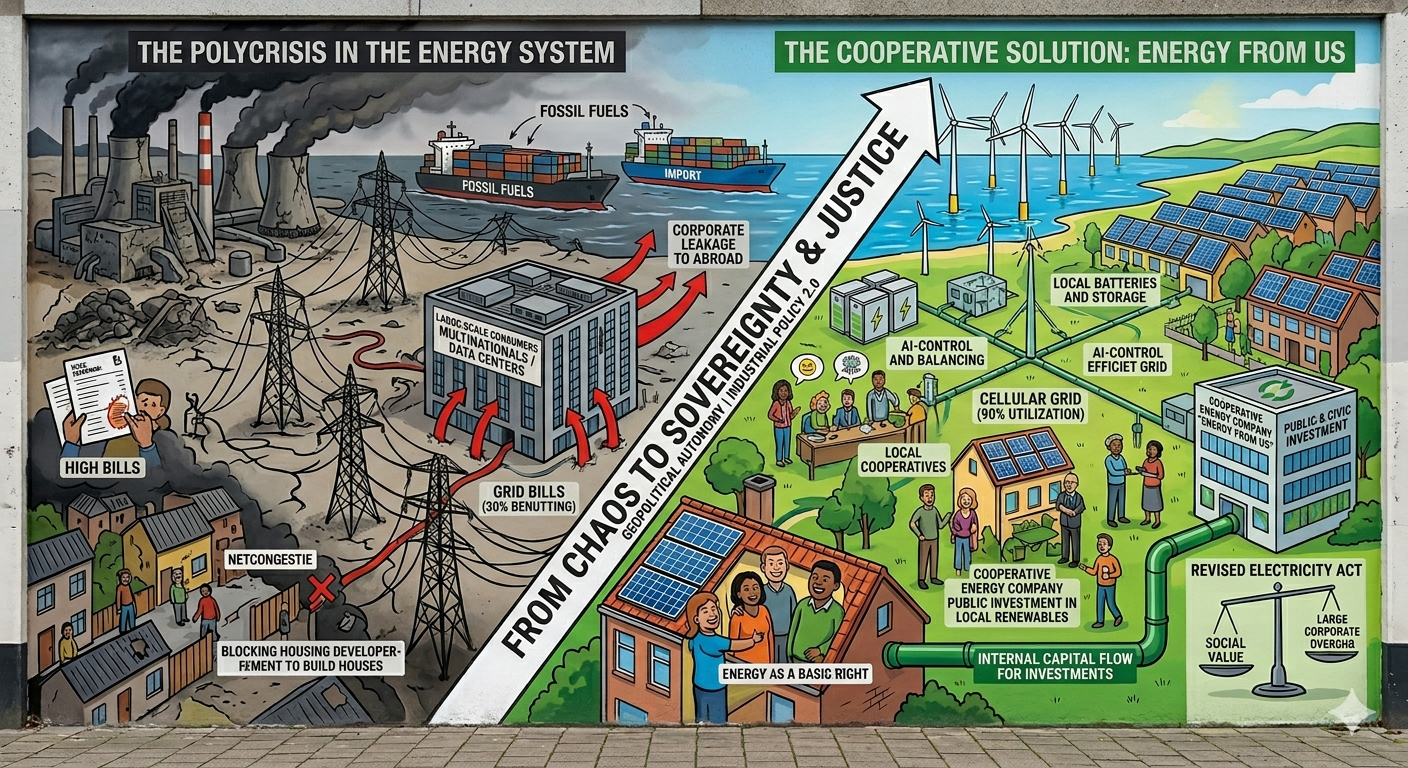
We feed the complexity of the Dutch energypolicy into Gemini and asked to make a proposal. The total dialog can be found here. The result was this:
Policy Proposal: "Systemic Energy Sovereignty 2026"
This proposal redefines energy provision as a public-civic good. It shifts power from extractive multinationals to a decentralized, equitable, and financially solid system.
1. The Foundation: The "Zeitwende" Architecture
We move away from the centralist model. The new energy system is cellular: energy is generated, stored, and consumed as locally as possible.
-
Grid Operator Stewardship: The Electricity Act will be amended. Grid operators will become "System Directors." They will be legally mandated to prioritize connections based on a Social Value Index (Housing > Non-essential Industry).
-
Optimization over Expansion: Instead of wasting €200 billion on physical grid expansion (cables), the state will invest in the "intelligent layer": AI-driven balancing and local storage.
2. The Cooperative Revolution: "energy of us"
Following the model of "Land van Ons" (Land of Us), we will establish a national-cooperative energy company: Energy of Us.
-
Public-civic ownership: The state provides the initial capital (see financing), but ownership and control rest with citizens and local cooperatives.
-
Offshore wind in public hands: New North Sea wind farms will no longer be granted to private foreign consortia but developed by "Energy of Us." Profits (the "interest on nature") flow back to society through lower tariffs instead of to shareholders in distant jurisdictions.
3. Equality & financial capacity: the "Maslow Guarantee"
For tenants and those with limited financial means, energy becomes a basic right.
-
Neighborhood batteries as a public utility: In lower-income neighborhoods and social housing areas, the government (via the grid operator) will install large-scale neighborhood batteries. these buffer cheap solar power during the day for use in the evening.
-
Abolishing the "cost-sharing norm" (Kostendelersnorm): By removing this norm, we encourage house-sharing, which drastically reduces the demand for new housing, energy demand and grid pressure per capita.
-
Tenant Benefit: Tenants gain direct access to the proceeds of collective solar panels without needing to invest capital themselves.
4. Industrial policy & geopolitical autonomy
We end the "parasitic" relationship with large-scale consumers.
-
Utility test: Multinationals and data centers will only receive a grid connection if they demonstrate social utility (e.g., providing waste heat, local employment).
-
Processor levy: Data centers will pay a levy per kWh or per unit of computing power. This revenue is earmarked for the local sustainability of Small and Medium-Sized Enterprises (SMEs).
-
SME priority: Local production companies take precedence on the grid over data distribution centers to strengthen the real economy and national autonomy.
5. Financing: The "great realignment"
The billions required for this transition will be redirected from system-distorting budget items:
-
Abolition of the "Innovation Box": Billions currently serving as a disguised subsidy for large tech firms will flow into the Local Storage Fund.
-
Tackling Tax Havens: By cracking down on corporate profit shifting, we generate the resources for the public procurement of wind farms.
-
Defense & Security: A portion of the defense budget will be reallocated to "Energetic Security." True security in 2026 means independence from foreign energy blackmail, not just military hardware.
Systemic Impact (Social cost-benefit analysis)
| Aspect | Old System (Project 1) | New System (Project 2) |
| Costs | €200-300B (grid reinforcement) | €60B (storage + smart steering) |
| Ownership | Foreign multinationals | Cooperative (Citizens/State) |
| Grid Utilization | 30% utilization (congestion) | 90% utilization (via buffering) |
| Social Impact | Tenants pay the bill | Energy as a basic right (Maslow) |
Question and how to go from here?
Does this article resemble within the World Adaptation Community?
Like to know the response. info@harmenbos.nl or 0031 6533 879 66
References
- IDS Annual Lecture 2026 with Jason Hickel
https://www.youtube.com/watch?v=tZh4oAlTxIw